
Strawberry Fields
Lyrics Interpreted

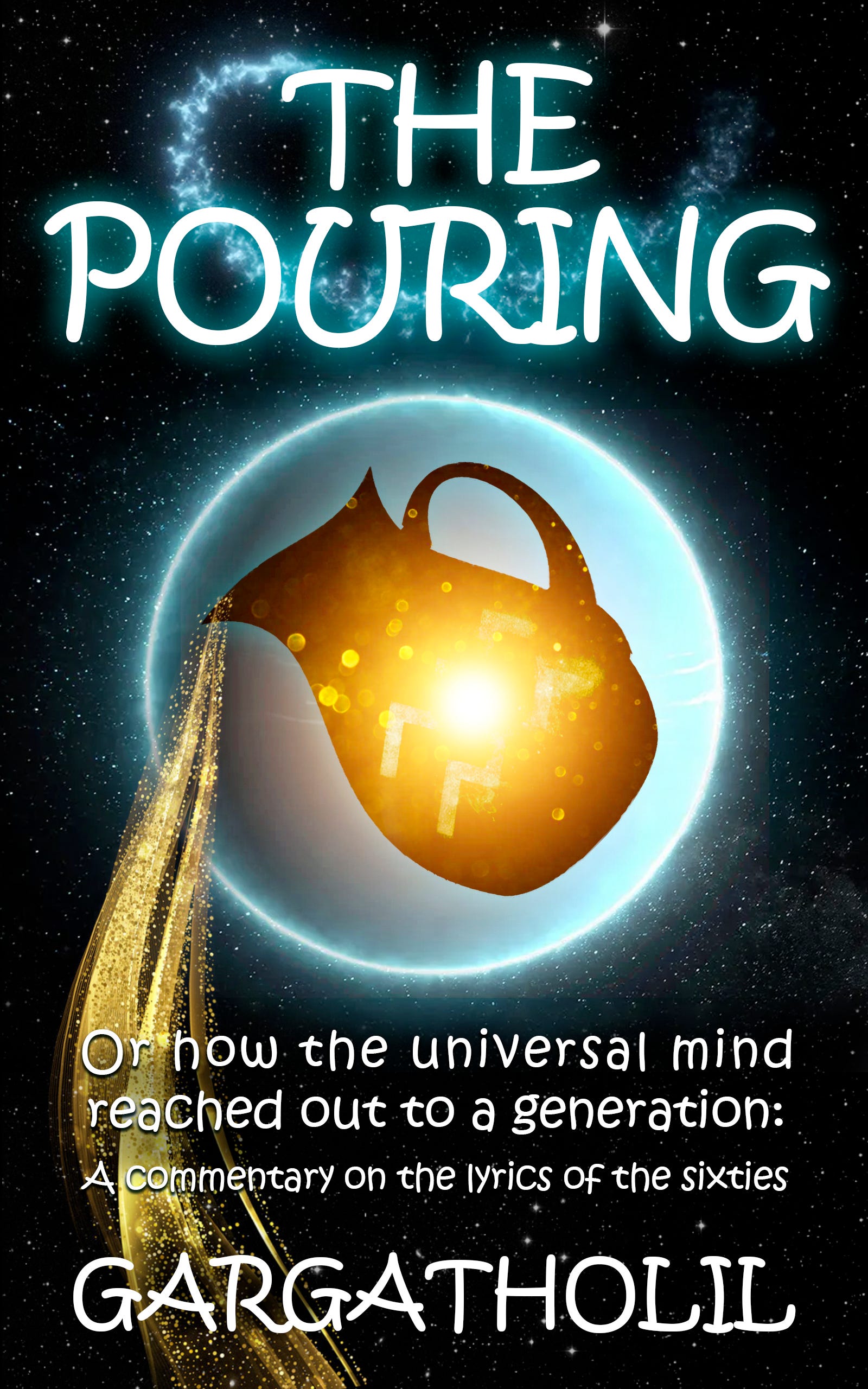
Strawberry Fields by The Beatles, found on the Magical Mystery Tour album and also released as a single, is ranked #7 in Rolling Stone magazine’s list of 100 all-time great rock songs. Gargatholil’s premise is that, during the Sixties, the Universal Mind was pouring out content through the music of the Counterculture. In the book, The Pouring, How the Universal Mind Reached Out to a Generation: A Commentary on the Lyrics of the Sixties, Gargatholil offers an interpretation of more than 800 songs from this period as they, and many others of that generation, heard them. Here is the meaning heard in Strawberry Fields. (The fact that there are no direct quotes of lines in the song is courtesy of the music publisher, who refused to allow me to quote them using the Fair Use Doctrine.)
Strawberry Fields Forever
By The Beatles
Album: Magical Mystery Tour
Written by John Lennon, 1967
Strawberry Fields is obviously about a drug-induced altered state of consciousness, specifically a heavy marijuana high or, possibly, from some type of “downer.” This is indicated in the opening line of the chorus where the singer is inviting the listener to be taken downward as well as by the general lyrical content, which is extremely realistic in describing the thought process of someone who is stoned. The question is, what is the real message of the song? Is it a “glorification” of the drug experience or is it an attempt by the Spirit convey the message that artificial consciousness raising is not as high as it feels?
Unfortunately, I think most of the Generation at the time, being ourselves steeped in the fog of psychedelic drug use, read this as an endorsement rather than as a warning. After all, we were quite “comfortably numb” swimming around in astral borderlands. Looking at these lyrics from a more sober and aware vantage point, however, they paint a picture of a mind caught in serious confusion.
Yet, it isn’t any wonder that, for most of the Generation, Strawberry Fields became a song through which we could bond with each other over our shared experience of psychedelic reality. The song’s lyrics reinforce Countercultural perceptions and attitudes that were molded from both the drug experience and independent realizations. Strawberry Fields becomes a metaphor for a worldview that is available through psychedelic drugs, particularly marijuana.
The second line of the chorus states that nothing has any reality and there is nothing about which we should get hung up. Many in the Generation had come to the conclusion, whether pre-drug or reflecting on the drug experience, that the phenomenal world was relative and that nothing in the phenomenal world was absolutely real. It all depended on what level you were on.
If nothing is real in the world of experience, then there is no reason to become attached to anything because you would only be trying to hold onto something that really wasn’t there. Although this is an affirmation of the Buddhist/Zen/Vedantic ideal of non-attachment, in the stoned experience this feeling of non-attachment was usually a result of drug-induced de-motivation. Nevertheless, “Strawberry Fields Forever” became a rallying cry for the supremacy of this relativistic worldview.
However, this idea of cosmic relativity is a slippery slope if one is not spiritually mature—which few in the Generation were at the time of the Pouring. Even thinking rationally about where this line of thinking leads can result in a pretty confused perspective. When this worldview is combined with the effects of marijuana, the results are predictable and described in the song’s verses. It is also easy to misinterpret these verses.
I think most people in the Generation rationalized that the first line of the first verse—about living with our eyes closed and misunderstanding everything—did not apply to them but must have referred to the Mainstream. In the next lines, though, the protagonist is clearly a member of the Generation and the shift of subject, while possible, is not plausible. Again, these verses are describing thoughts and feelings which many in the Generation considered to be quite normal.
The loss of identity described when the singer says that it is becoming difficult to be somebody was viewed ideologically as positive, since ego and the identity it attached to were known to be “bad.” The lines that follow about everything working out and not mattering to the singer—were viewed as a signal that this state of ambiguous identity was all right. It was part of the non-attachment. Alternatively, one could view these lines not as commentary on the previous line, but as a continuation of the description of this state of ambiguous identity. In other words, the song could be saying: look, you are losing your sense of identity which you need to function on this plane of reality and you are so stoned that you don’t care.
The next verse refers to the state of isolation frequently experienced in the drug-induced state and a consequence of the theory of cosmic relativity. If nothing is real, then that also means that no one else is real and that I am all alone, existentially. Or, even if others are real, I am the only one viewing the show of existence from this particular vantage point and, therefore, there is no real communication that can be taking place, since everyone is confined to their own individual vantage points, which are inaccessible to everyone else.
Thus, no one is seeing and feeling what I am seeing and feeling. We are all at different levels of reality—different trees—even if the frequencies of vibration have very small separations, so everyone else is on a frequency or level either higher or lower than mine. You can’t really tune into my frequency, because you are locked into your own frequency. The soul realizes that it is not a good situation to be caught in this cosmic trap of isolation but, being hopeful, we think, along with the singer, that it may not be too bad a thing.
The first line of the last verse has two alternative hearings. The first (the official lyric) begins by stating that the singer thinks it is themself all of the time, but then says: no, it is only some of the time. This suggests a more heightened state of confusion. Yet, the singer asserts that they can tell the dream from the reality. Is this claim to be met with skepticism by the hearer? Or is the message: “I know that this is all a dream but you, my friend, think it is real.” Should we take the first phrase of this line to mean that the singer always is aware of the intense subjectivity through which the world is seen, to the extent that the world is but a reflection of their own ego, but that they are ultimately unsure about this?
The situation is no less clear if we hear the line as saying that the singer always knows but that they think that it is themself some of the time. Here, the object of “know” is ambiguous. This may be a claim to gnosis. In other words, even though sometimes our mind is forced into the rational conclusion of radical subjectivity, something else inside of us knows the reality that the All is more than just our own ego-perspective. Or, in a darker reading, the protagonist claims an inner certainty of radical subjectivity, even though their mind may doubt it from time to time.
Regardless, the remainder of the verse plunges us into a state of agonizing uncertainty even about what we believe. This, unfortunately, was an all too common state arrived at through being stoned or tripping. Meanings change with such abruptness and contradictoriness with each level of consciousness and if a person was operating on more than one level simultaneously then the logical contradictions experienced in the lower astral realms brought thorough and catastrophic confusion to our minds. After all, we could only ultimately process our experience through our rational minds. It was not an uncommon state of being to Know with certainty and to doubt everything we knew.
If you like this post, give it some love by clicking the icon below, share this substack, and buy the book!
Gargatholil is right to say “Strawberry fields” is about a drug-induced state of uncertainty, but the writer goes too far when questioning whether it is an endorsement of the magic carpet that got the song’s narrator there.
Not to say Gargatholil is wrong to raise questions. Great art often comes to mean more than intended, and vitality suffers if art is closed to interpretation. Francis Scott Key would have been appalled by what Jimi did to his “Star Spangled Banner.” But tough, Franny. Jimi made your ditty immortal by using it to bring up the violence America brought to Vietnam. Our National Anthem, thanks to Hendrix, is not just about the battle over a Baltimore harbor fort. He raises it to the third power because it now speaks to the universe in all dimensions.
It went from one of the world’s most famous anthems to perhaps its most moving. (Think of what the movie “Casablanca” did for the French anthem.)
John Lennon wrote “Strawberry Fields” in 1966 as the U.S. commitment to Vietnam was expanding and soldiers were dying. Our boys weren’t losing; they were engaged in a tactical stalemate. Any betting fool will tell you a tie favors the home team, the Viet Cong.
The U.S. was also facing racial strife, class disputes and an illegal drug culture. Kids wanted to “turn on, tune in and drop out.” Who could blame them? Not John.
And here comes this Beatle — a serious poet, you can bet your Bob Dylan Nobel on that. He found himself stuck on a plane of pain with no exit until his absurd 1980 assassination. He had studied Eastern mysticism in India, and amidst the Western chaos and conflagration, he imagined a stoned narrator who finds a substantial and philosophical way out: “Reality” is not real. Nothing is. That goes two ways.
Lennon’s lyrics here are among his best. The poem is an example of organic writing because it not only talks about confusion, it creates it as the narrator contradicts himself, undoes statements of certainty with a qualifier or switches thought in mid phrase as if he can’t say anything definite about anything. WTF is real, anyway?
Thus the narrator’s dilemma: Do I accept a world of pain or seek escape? A heavy dose of Acapulco Gold and a touch of Eastern insight may do the trick. When one is high and enlightened, pain is unreal. It is the Eastern mystic’s answer to suffering: The reality we think is real is unreal. Mind altering drugs may well be the quick-and-dirty way to achieve the Buddhist/Zen/Vedantic ideal of non-attachment. Without attachment, there is no pain.
No army can withstand a message whose time has come. Everyone knows the song; it is part of the 20th century canon, like much of Lennon. It made sense in its day; there are times, too many times, when it feels like wisdom now.
Gargatholil would probably accept much of the above blather, but the writer goes on to raise questions I don’t think were on Lennon’s mind, but seem obvious now. Is escape via drugs valid? Does it lead to a sustainable non-attachment to the ever-changing, occasionally quixotic Veil of Maya, the insubstantial world most consider reality?
Probably not. So far as we know, Siddhartha Gautama did not use pot and/or psychedelics to gain enlightenment. And he wasn’t into craft beer.
A case can be made for Gargatholil’s interpretation in the first line after the opening chorus: It’s easier to live in a terrifying world with eyes wide shut. I first took that as a recommendation for the narrator’s escape. Looking back today, the line could also be a criticism of that escape or a barb at the average person, whose mind and eyes are closed to the surrounding terror. Maybe this lack of awareness creates the terror.
Is the narrator the poet’s heroic voice or that of the riffraff who are the problem?
Subsequent verses are also open to interpretation. This keeps “Strawberry Fields” relevant. As long as “What is real?” is asked, the song will remain so.
“Strawberry Fields” lives like Werner Heisenberg’s uncertainty principle. What can’t be known for sure endures forever.