
Cube (the Movie)
An Existential Allegory

Cube is a Canadian science fiction horror film released in 1997. When I watched the film, I recognized it as a symbolic allegory for the human condition. Whether the film makers intended this or even recognized this is irrelevant, as art speaks for itself.
The allegorical features of the film are general in nature, so there are many plot occurrences that are not allegorical but simply exist to make the movie interesting and entertaining, and to provide suspense, drama, character development, and action. Some of the allegory is implied, rather than being apparent. This keeps the movie from being dogmatic or heavy-handed in its messaging.
A general summary of the plot is that a group of people find themselves in a series of cube-shaped rooms, many of which contain deadly traps. The rooms are connected to one another by hatches. Each hatch has a numerical code. After one of the party is killed by a trap, they are joined by, Kazan, an idiot-savant who is a mathematical genius. They figure out that the hatches’ numerical code indicates rooms with traps, versus safe rooms, and Kazan is able to decipher the code so that the group can proceed from one safe room to another. One of the group, Worth, worked on the design of the exterior shell of the Cube and this allows the group to deduce that there is an exit from the Cube if they can reach the correct room at the perimeter of the structure. Along the way, another member of the group, Quentin, turns murderous. He is ultimately mauled by Worth and exiled from the group. Worth, Leaven (a woman with whom Worth becomes romantically involved) and Kazan make it to the room that has the exit hatch. However, the Cube turns out to be something like a Rubric’s cube. The rooms constantly shift into new positions, although this movement is not obvious until one is at the perimeter of the Cube. There are 17,577 rooms in the Cube, including the room with the exit. That room aligns with the opening in the shell of the Cube only once in 17,577 rotations of the Cube. Thus, the chance of escaping the Cube is extremely rare. One must not only be in the correct room, but one must be in that room at the correct time.
Worth, Leaven and Kazan figure out that the escape alignment is imminent. When the room with the escape hatch moves into proper place, it opens revealing an intensely bright white light outside. At that critical moment, Worth and Leaven linger, lying together resting on the bottom hatch of the room, exchanging vows of their enduring love. The hatch opens from below and Quentin appears and impales Leaven with a metal rod, killing her. Meanwhile, Kazan walks out of the Cube. Quentin, now emerged from the hatch, attempts to follow but Worth holds him back, half-way through the opening, and he is killed when the door closes and the rooms move again. Thus, Worth (and Leaven) misses the opportunity for escape. Kazan walks into the Light obliviously performing mental calculations.
The Cube symbolizes the Creation, at least at levels up to the Oneness of Universal Mind. It is a world where death is constant and unpredictable. Although reincarnation is not explicit in the film (no one who has died is shown to return again to the Cube, although Quentin’s reappearance after his assumed death suggests the motif), the constant traveling from room (body) to room suggests this.
The people in the Cube are trapped. There is no apparent escape. There are clues, but they are indecipherable without specialized knowledge (that of a mystic). Knowledge of the possibility of escape comes only by great good fortune. Worth opines to Quentin at one point that he thinks the Cube was created accidentally and that people were put in it only to justify its existence. This resonates to the belief by some that, given its imperfection, its suffering, its apparent essential meaninglessness, its illusoriness, and the ruthlessness with which it traps souls within it, the Creation must be some cosmic accident or mistake.
There is only one room (the human form) where escape from the trap of the Cube is possible. There is only one time (when human awareness and will align with the opportunity to pursue a spiritual path through which moksha can be achieved) when escape from the Cube is possible.
The last scene in the movie reminds us of the trap of attachment. Attachment distracts us from focusing on the real task of human life – achieving Liberation. It was Worth and Leaven’s attachment to each other that distracted them from easily passing through the portal and into the Light. The last scene also brings implications of karmic consequence. Worth, rightly or wrongly, had pushed Quentin to his intended death. Quentin’s revenge can be viewed as karmic consequence.
Kazan is the only figure in the movie without attachment. He is innocent, egoless. One might see an absurdist irony that the only person to escape into the Light appears to be oblivious to what they have accomplished. It is a cosmic paradox, certainly, that when one reaches the stage of union with the Divine, there is no longer any “I” to experience that blissful state (though incomprehensibly that Bliss is nevertheless experienced).
In the Qur’an. It is written: We shall show them Our signs on the horizons and in themselves until it becomes clear to them that It is Real. Thus, we may find symbolic truth illustrated in strange places.
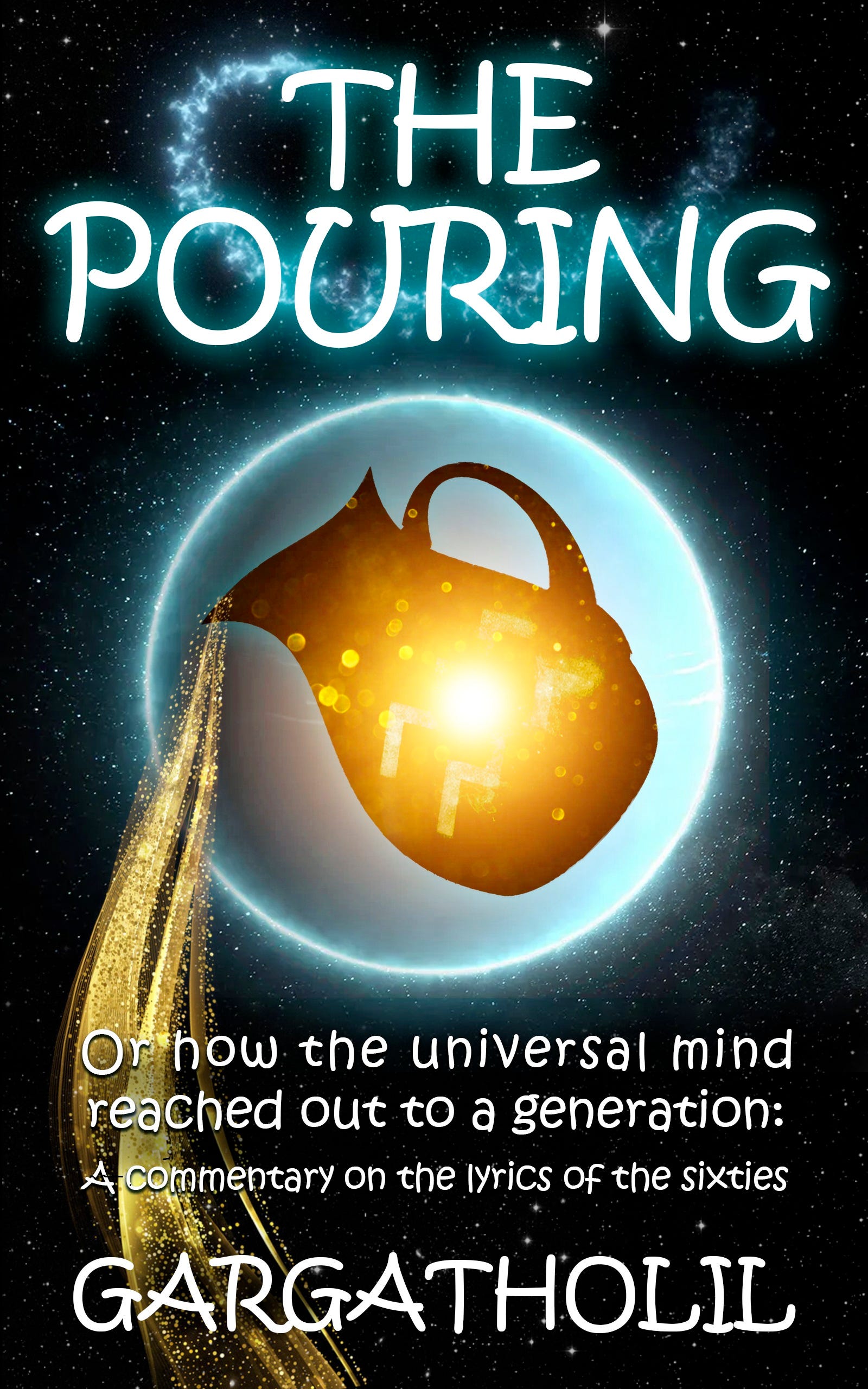
If you enjoyed this analysis, you may also enjoy my analysis of some 875 songs from the sixties Counterculture, lyrics written by more than 70 artists, in my book, The Pouring, Or How the Universal Mind Reached Out to a Generation: A Commentary on the Lyrics of the Sixties. The Pouring is available as an e-book from Smashwords.com and from Amazon in print. The e-book has links to the song lyrics online. The print edition obviously doesn’t so you have to search on the internet for them - quite easy to do.
Also, please give this post some love by clicking on the heart below, tell your friends about Gargatholil’s Substack, and subscribe to my Substack if you are not already a subscriber.
This sounds like an intriguing movie. The film seems obviously allegorical whether or not the filmmaker or any of the characters are aware of it. Gargatholil is right. Art always speaks for itself.
Interestingly, Gargatholil's analysis goes on to reference the Qur'an. It could just as easily have referenced Buddhism, a religion which questions not only the nature of reality but also the nature of the self, not to mention the nature of nature. "Cube," unless I am misreading Gargatholil, seems to do all of this. The mystery of life is solved only by being in the exact right place at the exact right time, independent of whether a person is trying to understand reality or is interested in or is aware of being in the right place or happens to be wearing a watch or has a cell phone with them at that exact moment in time. (Einstein would have loved this movie.) It's all luck. Life, existence and nature itself are a lottery cubed. That seems about right. It's all luck. Merit and faith are for suckers.
The movie is a Canadian production. Canada is a surprising place. It gave us Neil Young, the Guess Who (as well as the not-to-be-overlooked Bachman Turner Overdrive), Fergie Jenkins. the Trudeaus, hockey, a refuge for war protesters, a supporter of and home for Native Americans, and the U.S.A's best friend (pre Trump).
Does Tarantino know about this film?